

Why carbon capture’s biggest challenge is not technology: an interview with Kim Kyu-nam
- Minju Chung
- Dec 1, 2025
- 6 min read
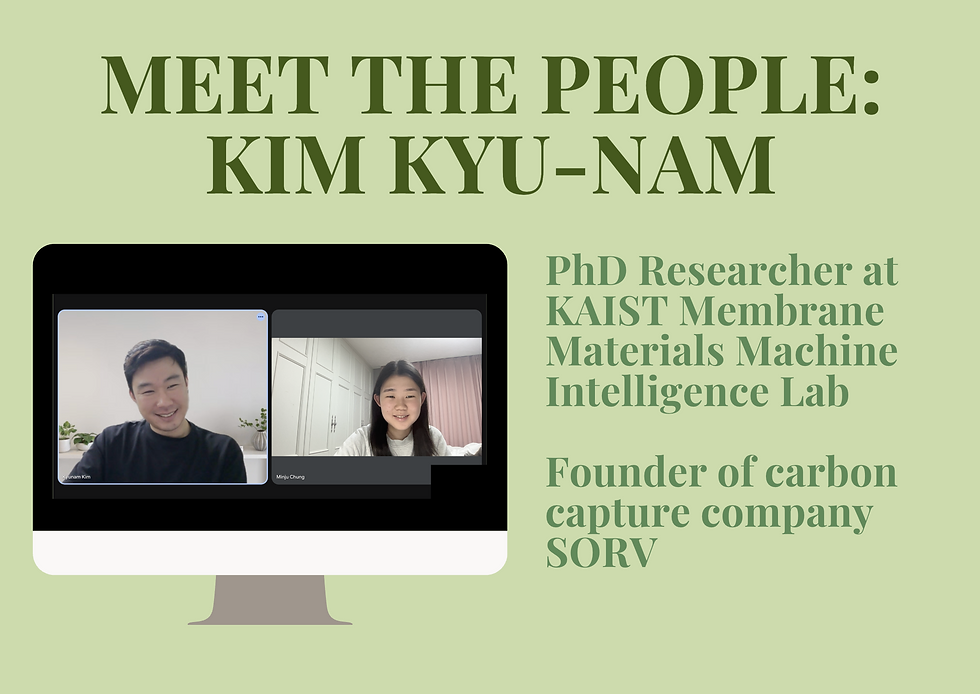
While carbon capture is an innovative technology to achieve net-zero by removing emissions from the atmosphere, several challenges lie in its expansion for industrial usage. Kim Kyu-nam is a researcher who focuses on scaling carbon capture technologies from lab research to real-world, industrial production. Dr. Kim expressed that achieving net-zero requires both transitioning to clean energy and removing unavoidable emissions through carbon capture and expressed concerns for its lack of a stable market and supportive policy.
Could you first briefly introduce your current research focus and carbon capture technologies?
If I walk through my resume, I studied chemical engineering at University of Illinois. The key of chemical engineering is transforming energy and matter into other forms of energy and matter. Basically, you are making something out of something else. It could be materials or energy. It is very broad, but the key is that it has to be at scale. You want to make something not just at the bench-scale or lab-scale, but something that can be produced in large quantities and scaled. Scale is the key.
After graduation, I continued my studies, which is why I went to graduate school. My doctoral thesis focused on separation and absorption. Basically, if there is a mixture of two different things, A and B, you place a membrane or something else in between. At the end of the process, you get A and B in separate streams. There are two different ways: you can absorb A and let B come out the other end, or you can use a membrane in the middle so that A and B come out in separate streams in a continuous fashion.
Carbon capture is not very different from that. You let air into a system packed with an absorbent. The system absorbs CO2, while other components like nitrogen and oxygen, which are unreactive to the absorbent, pass through. You absorb CO2 and then put it to better use or store it.
Carbon capture itself is a very simple process and has been around for several decades. The process was largely established 20 to 30 years ago. The harder part is direct air capture, not capturing CO2 from flue gas. If you look at factories or power plants, the smoke coming out of chimneys is a mixture of water, air, and CO2, with CO2 making up about 5 to 10 percent. The accumulation of those emissions is what causes climate change. The harder process is capturing CO2 directly from the atmosphere, where CO2 concentration is only about 0.04 percent. The difference between 5 to 10 percent and 0.04 percent is like finding a needle in a haystack. The process is very complicated and technically demanding.
I started working on this because it is a problem we are facing globally. What we do is tackle these problems and try to solve them, with the idea that all these solutions will eventually come together to address the problem as a whole. I focused on scalable direct air capture systems, working on production, system building, and engineering.
At the end of my PhD, I looked back and thought about who else could do this in South Korea. These technologies have been developed for a long time in Europe and the United States, and climate technology there is far ahead of what we currently have in Korea. As a Korean myself, I asked who else could do this in Korea, and there really was no one. So I thought this is something engineers need to do.
That is how I founded this climate tech carbon capture company, focusing on scaling up what I worked on during my PhD. Right now, we are constructing a system that can absorb about 10 tons of CO2 per year from the atmosphere, which can then be attached to other systems for storage. The goal is to move CO2 from the atmosphere to underground or somewhere else.
What do you think is the biggest challenge moving forward?
So, I think there are 2 different problem solvers. First, it's like the big tech companies or those entrepreneurs. Basically, if you look at NVIDIA, for example, they're essentially solving a problem in AI by producing their GPUs. Before, they were using their GPUs for computer graphics, which was solving problems in the gaming world. And they're making big money out of it because it's a very profitable market.
But let's look at something else. UNICEF, for example. They're solving one of the biggest problems that we have, like providing food and healthcare for children in the underdeveloped world, but they are not making money out of it. So I think there are 2 different types of problem solvers: those who solve problems that are profitable, and those who solve social or global problems, which are important but not profitable.
And I think climate change, climate tech, essentially, what we're doing right now lies in the latter, not the former. As of now, it's like picking up trash. You walk around the streets, pick up trash, and put it in the bin. No one's going to give you money because you did a decent thing. People clap for it, but they don't necessarily want to give you money for it.
I think as of now, the biggest problem is there is no sustainable market for climate tech, especially for direct air capture. And after the market, you have to assess the technology. Do we have decent enough technology that can penetrate or create a market so that we can run this business sustainably and successfully? No engineer will say their technology is perfect. There is always room for improvement. Those two are the biggest problems that we have.
In a larger sense, what role do you think carbon capture can play in achieving national and international net-zero goals?
If you look at carbon emissions on a broader scale, people tend to think about chimneys and car emissions, and that switching from gas cars to electric cars will reduce emissions, but essentially it's not enough. Global carbon emissions in 2023-2024 were around 39 gigatons per year. Most of that comes from energy production. Transportation and coal-based or steam-based generators are major sources. Overall, emissions are tied to how we produce and use energy.
To achieve net-zero emissions, there are two things. First, switch the energy mix to renewable energy, such as solar, wind, geothermal, hydro, and nuclear. These produce much less carbon dioxide. This is important because capturing carbon while still emitting it is like cleaning snow while it's snowing. You have to stop the snow first.
Second, there are unavoidable emissions. For example, airplanes cannot easily switch to electric because the energy density doesn't meet requirements. In those sectors, we need carbon capture and removal. You can't put carbon filters on airplanes because it would be heavy and inefficient. That's where direct air capture comes in, to remove unavoidable emissions, often called scope 3 emissions.
We still have to produce gas, plastics, and chemicals, and all of those emit CO2. Carbon capture captures those emissions so that ultimately nothing is released into the atmosphere. Only then can we achieve net zero.
Do you also collaborate with CCS projects?
Yes and no. It's very ironic. During my PhD, my CCUS project was funded by Saudi Aramco, which is responsible for about 4% of global historical emissions. That was ironic because our biggest collaborator and investor was an oil company.
If you look at the industry, most carbon capture and removal projects are funded by oil companies like Chevron or Oxy. Even in South Korea, companies like GS and Hyundai Oil are investing small portions. It's still very minute compared to other parts of the world.
Right now, not many private companies are focusing on carbon capture because the economy is bad. But we are still working with local governments, who are dedicated to making this technology last so it can be deployed in the future.
How does carbon capture research link to CCS and CO2 utilization?
It definitely links to CCS. Many universities, like KAIST and other institutions, focus on using CO2 to produce something else, which is very difficult. Thermodynamically, CO2 is very stable, so it's hard to use it as a reactant. You can do it, but the energy input often exceeds the benefits.
A more sensible approach right now is storage or limited utilization. For example, in Switzerland, captured CO2 is fed into greenhouses to support plant growth. Another method is storing CO2 in basalt rock formations, like in Iceland, where CO2 is injected underground and mineralizes over hundreds of years.
What is the biggest barrier to scaling carbon capture in Korea, and how can it be overcome?
The biggest barriers are technology, cost, and policy. The technology exists, but the question is whether we are using the right technology. Life cycle assessment is important because producing absorbents, transporting materials, heating systems, and operating fans all emit CO2.
Direct air capture uses thermal-based absorption cycles, which require heating absorbents to around 100°C multiple times a day. This is very costly. Producing absorbents, engineering systems, and manufacturing components also cost money. Energy equals cost.
We can reduce costs in two ways: make systems more efficient or make energy cheaper. Nuclear, solar, and wind provide cheaper electricity. Nuclear is the cheapest per unit, and solar and wind are also very cheap.
On policy, Korea recently announced new NDC goals toward 2030. This is good for nature, but the challenge is how to achieve those goals. Most policies focus on switching energy sources. I think everything should run in parallel, renewables and carbon capture together because scope 3 emissions still need to be addressed. Policies should be balanced toward both energy transition and carbon capture.


Comments