

Beyond borders in global renewable energy: an interview with Ji Sang-hyun
- Minju Chung
- Aug 24, 2025
- 4 min read
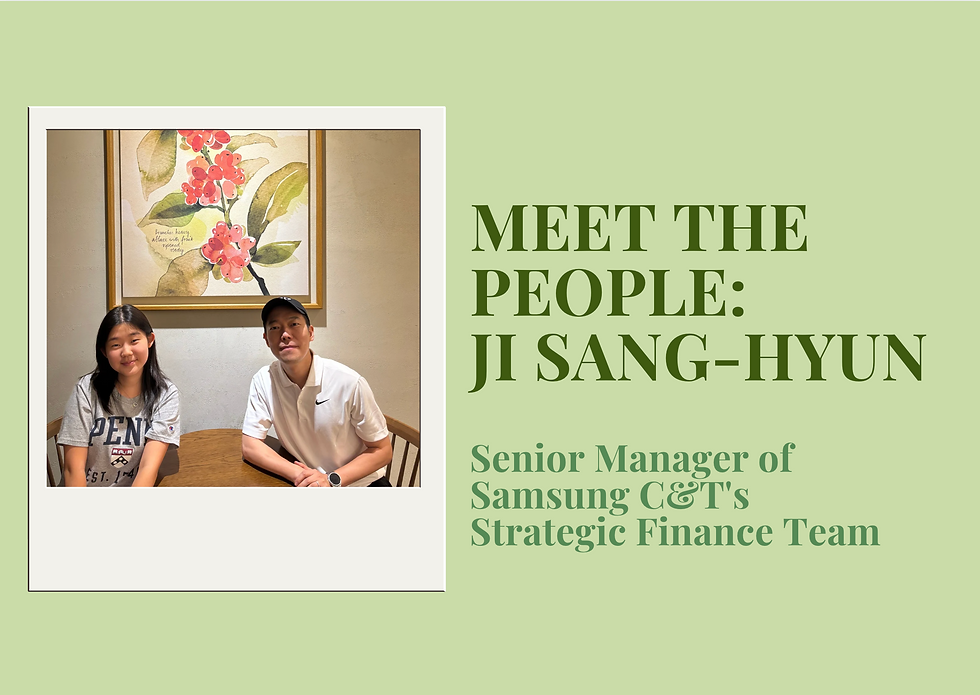
As the most promising strategy to reduce carbon emissions, renewable energy continues to gain the most attention and investments. Behind the growth of renewable energy is the combined effort of researchers who develop technology, governments that create regulatory policies, and companies that invest in large-scale projects to run renewable energy power.
A business with a unique strategy of investing in overseas renewable energy projects is none other than Samsung C&T. Ji Sang-hyun, Senior Manager of Samsung C&T's Strategic Finance Team, shared insights of the success factors of the company's renewable energy projects, as well as challenges and opportunities for the technology.
What kind of renewable energy projects are you investing in?
Our company builds renewable power plants. We mainly operate in the US, Canada, Australia, Germany, and Japan, but the biggest projects are in the US and Canada. Renewable power plants include solar power plants that use panels to convert sunlight into electricity, and wind power projects where turbines, basically giant windmills, are installed. In Canada, we mostly do wind power, while in the US it’s solar power.
What made the company decide to start investing in these projects? Was it mainly for environmental reasons?
Yes, it was a mix of both environmental and business reasons. Samsung is well-known, and like any company, we have a board of directors. About 6 years ago, the board decided that we should focus on carbon reduction and eco-friendly projects as a new business strategy. We used to work in coal power too, both domestically and internationally, including coal trading. But since coal generates a lot of emissions, we withdrew from it entirely.
Another reason is that renewables are profitable. Around 5 years ago, solar panels were still very expensive. But as technology improved, the costs dropped and efficiency increased. Now, panels are smaller, more versatile, and cheaper, so it became more preferable for us to invest in.
So, on one hand, it’s about maintaining Samsung’s brand value from an ESG perspective. But beyond that, renewables make money. Currently, about 20% of our company’s revenue comes from renewable energy projects.
Since your business is active in many countries, is there a project that has been particularly successful?
Yes, our projects in Canada have been very successful, and the US projects we’re currently running are also doing well. The reason why these projects were successful in particular is that renewables are relatively new industries, so stable government policies and laws are essential. Countries like Canada and the U.S. have reliable legal systems, which gave us the confidence to operate without major losses. Even though there have been some changes in US policies since the new administration, overall, it’s a highly trusted society, so we were able to do well.
On the other hand, we had failures in some Eastern European countries like Romania, Bulgaria, and Italy. Governments there suddenly changed subsidy policies when administrations shifted. Originally, we expected a certain level of revenue with subsidies, but when those were cut, funding collapsed and profits fell. As a result, we had to withdraw after suffering losses.
Considering those financial and regulatory challenges, what are your future investment directions?
The first step in deciding investment direction is choosing the country. Samsung C&T’s trading division, which is my department, only does overseas business, unlike our construction division, which builds domestic apartments and power plants.
When choosing a country, the most important factors are regulations, government will, and trustworthiness. That’s why we focus on politically stable countries like Canada, the US, Germany, Australia, and Japan.
Since I work in the finance team, I also emphasize funding. No company finances an entire project with its own money—we always borrow part of it. The key is how cheaply we can borrow. That depends on whether the country has a well-developed financial industry. Countries like the U.S., Canada, and Australia have advanced financial systems, making it easier to secure project funding.
Aside from political stability, what else do you consider when identifying investment opportunities?
After choosing the country, we analyze its industrial structure. For example, in Korea, the electricity sector is dominated by a few big companies, often state-owned ones like KEPCO, so the industry is heavily controlled by the government.
In contrast, the U.S. system is fragmented. Each state has different rules, and within states, different companies handle different parts of the value chain—like land development, construction, grid connection, and electricity sales. This fragmentation allows companies like ours to participate. In countries where one giant company handles everything, it would require massive capital (tens of trillions of won) to compete. But in fragmented systems like the U.S., even smaller players can take part and make profits.
So, in some cases, do you work with countries that are not yet developed in renewables to build the industry together?
Yes, that happens. For example, in 2010, Ontario, Canada, wanted to expand renewable energy. They were looking for business partners, and Samsung submitted a strong proposal, negotiated well, and won the bid. We built a large renewable complex, and Samsung was able to generate revenue by selling electricity there.
Why does Samsung C&T focus mainly on overseas projects instead of domestic ones?
That’s a very good question. The trading division of Samsung C&T is essentially a trading company. One of its strategies is to earn profits overseas and bring them back to Korea. The domestic market is smaller and more competitive. Also, doing business abroad isn’t easy because of unfamiliar systems and partners. But Samsung C&T has always had overseas experience, so instead of staying in Korea with small projects, we aim for larger profits abroad.
Renewable energy hasn’t fully replaced traditional energy yet. How long do you think it will take, and what needs to happen for full adoption?
I am not sure about how long it will take, but what is definitely needed is technological development. As technology advances, costs drop, making renewable electricity cheaper to produce. So, continuous research and development is crucial.
Another factor is stable policies. For example, in the US, building a power plant might cost 10 billion KRW, and the government provides tax credits covering about 40% of that. Without such subsidies, the electricity price would be too low to make the project viable.
But in the end, policy stability depends on public will. Politicians are elected by people, so if more people support environmentally sustainable policies, stable systems will emerge. The stronger that public demand, the better the chance for renewables to grow reliably.


Comments