

An honest reflection on corporate climate commitments: an interview with Kang Yeong-seok
- Minju Chung
- Mar 21
- 4 min read
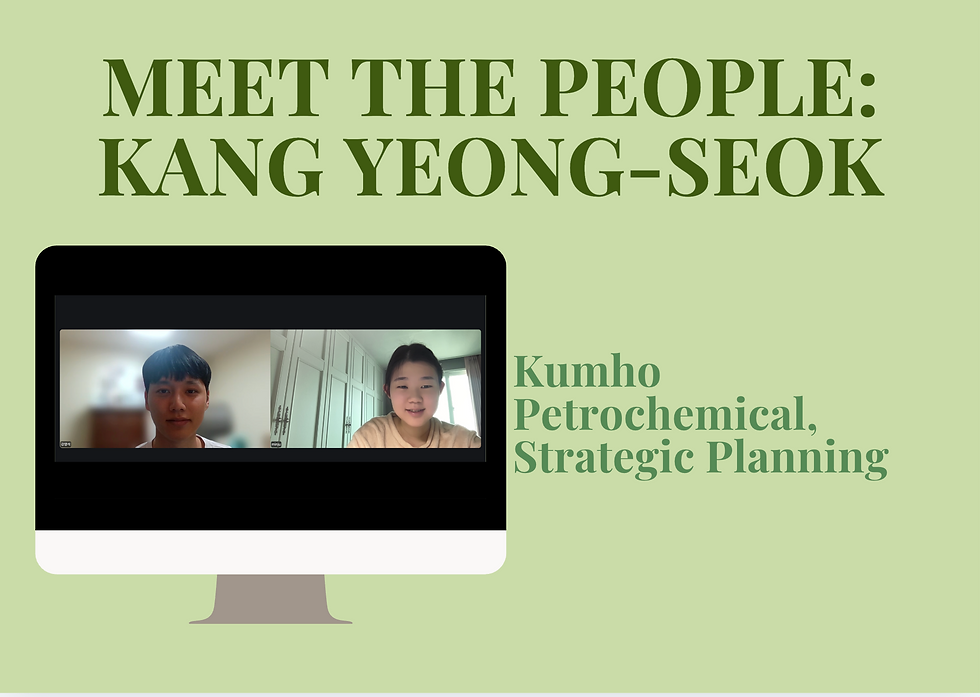
The scope of ESGs is gradually expanding to hold more emitters responsible for the environmental footprint they leave behind, yet many face challenges adopting significant changes. In this interview, Kumho Polychem's strategy planner Kang Yeong-seok provided an honest perspective on the persistent status of ESG as recommendation rather than legal obligation, as well as how his company has made efforts to build ESG compliance.
First, could you tell us a bit about the job you’re currently working on?
Yes, I work in the Strategy Team at Kumho Polychem, a petrochemical company, where I’m in charge of the ESG division. To be precise, there isn’t any specific legislation regarding ESG in Korea yet. And even in places like Europe, there aren’t any legal requirements for ESG just yet. However, since we need to stay prepared, there are many factors to balance. I’m working to help our company strike that balance, implement changes step by step, and establish the necessary systems.
In a petrochemical company, I imagine there are significant greenhouse gas emissions. Are there any areas you’re prioritizing to reduce environmental impact?
Well, based on what I know, the main issue is the chemicals we use to manufacture our products. We’re currently focusing a lot on developing these chemicals so that they themselves emit fewer greenhouse gases. In addition to that, we’re introducing new machinery and focusing on implementing technologies that allow these machines to recycle gases. Looking further ahead, we also have strategies to capture carbon and store it underground to prevent emissions. However, those are still mostly theoretical concepts at this point.
Aside from the environment, are there any specific ways you think the company has changed significantly since adopting ESG management?
Yes, our image has definitely changed. After all, the very fact that we’re a chemical company makes people think we’re not exactly eco-friendly. But we’re starting to shift that perception by showing that we’re making a real effort. One of the ways we do this is through a global certification called EcoVadis. It’s not just a certification; it’s more like a global medal. When we submit our application, they award us a rating—Bronze, Silver, Gold, or Platinum. But getting that certification is a real hassle. There’s a lot to do, and it costs a lot of money, because we pay for consulting services to prepare for it. But once you get one—if you do it right—it counts as certification. Fortunately, our company has received the highest rating for two years in a row.
There’s also an ESG report—it’s a document that compiles all the ESG activities and efforts the company has undertaken over the past year. The system is structured so that if the report is well-prepared, we receive a higher score. So, we focus first on making the effort and creating the report, then use that as a basis to obtain certification. When we receive a good rating, it really boosts our public image.
Since you’re on the Strategy Team, I imagine there are many factors to consider when making these ESG efforts. For example, many companies these days are prioritizing initiatives like RE100 or Net-Zero. As a member of the Strategy Team, how do you balance the need for realism with the mandate to achieve these targets when setting such goals?
First of all, regarding RE100 or Net-Zero, I’m with a subsidiary of Kumho Petrochemical, and it seems the Kumho Petrochemical Group has laid out a fairly detailed plan. In fact, at our level—just me and my team leader—we’ve only established a rough plan. So, for example, this year, we know what the greenhouse gas emissions were last year and we’re simply planning to reduce them by introducing specific equipment or technologies in certain areas. We’re using that as the basis for our materials stating that we will achieve RE100 or Net-Zero.
But as I mentioned earlier, this is just the beginning. For this to actually be implemented, it will cost a tremendous amount of money, and we’ll need to test it in practice, so we still have a long way to go. However, the requirements for RE100 or Net-Zero are still at this level for now. So, it’s not about whether we can implement it more precisely; it’s more about having a plan and showing how we intend to proceed. That’s the level at which we’re currently managing things, and I think we’ll only know how realistic it is once we get there. If this becomes truly mandatory, we’ll have to assess its feasibility at that point. So, we’re just figuring out how to reduce emissions and documenting that.
You mentioned that you haven’t seen any specific details yet on how to implement these measures. Looking ahead to the near future, do you think this situation will change soon? Or, if these regulations are strengthened, what kind of implementation plans do you intend to develop?
Honestly, I don’t think things will get much stricter right now. To give an example, regulations on supply chains were actually relaxed last year. That’s because they were designated as law within Europe. There used to be something like the Supply Chain Due Diligence Act, but since it was too difficult to comply with, they went ahead and relaxed it completely in the early to mid-part of last year. And as for CBAM, although it has been discussed, the situation is actually still unclear even though the deadline is fast approaching. From what I’ve heard, the details have become ambiguous again. If you look at the industry’s perspective—and the petrochemical sector isn’t even included yet—I don’t think it will be strengthened further.
It’s just a matter of whether it gets legislated or not. Right now it’s mostly just a recommendation, so I think the question is whether it will be legislated to some extent or not—it won’t be easy to actually strengthen these regulations themselves. Because, realistically, it’s still very difficult, not just for our company but for everyone.


Comments